Biology 2019
Objective Questions
Which of the following structures will not be found in the nucleus of a cell?
Correct Answer: B. Lysosome
An example of organ level of organization is
Correct Answer: C. kidney
A structural similarity between Paramecium and Amoeba is the presence of
Correct Answer: D. one food vacuole
The classes of plants the root systems in diagrams I and II below represent respectively are
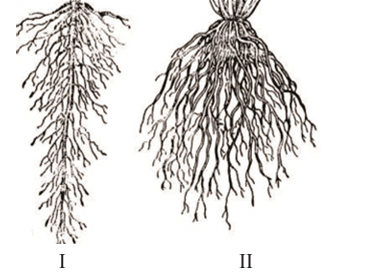
Correct Answer: D. Dicotyledoneae and Monocotyledoneae
The diagram below is an illustration of a stage in a biological process Study it and answer questions 5 and 6.
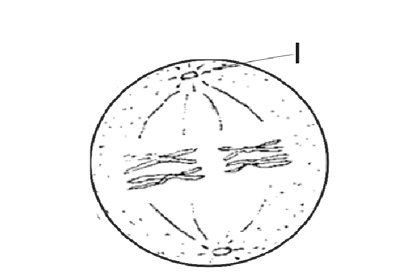
What stage of the cell division is illustrated in the diagram?
Correct Answer: B. Metaphase
The part labelled I is the
Correct Answer: A. centromere
The rate of diffusion of molecules between two media will be higher if
Correct Answer: A. there is no difference in the concentration of the two media
Anaerobic respiration in the organism illustrated in the diagram below produces carbon dioxide and
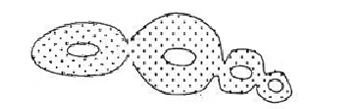
Correct Answer: D. ethanol
Underground storage stems which grow horizontally in the soil are
Correct Answer: B. rhizomes
Muscle fatigue in the body of an athlete is due to
Correct Answer: B. accumulation of lactic acid
The heart can beat continuously without being fatigued because it is composed of
Correct Answer: B. cardiac muscles
The product of tissue respiration are
Correct Answer: A. water, carbon dioxide and energy
Excretory products in plants responsible for the decolouration of flowers are called
Correct Answer: A. resins
The process of maintaining a steady internal environment is known as
Correct Answer: B. homeostasis
Which of the following statements is not true about hormones?
Correct Answer: C. They may affect more than one target organ
The diagram below is an illustration of a human brain. Study it and answer questions 16 and 17
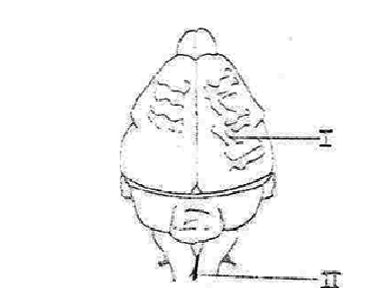
The part labelled I is the
Correct Answer: B. cerebrum
The function of the part labelled II is that it controls
Correct Answer: D. many involuntary actions
To focus on a distant object, the ciliary muscle of the eye
Correct Answer: A. relaxes and the eye lens gets thicker
The main function of the amniotic fluid is for
Correct Answer: C. protection of the foetus from shock
The diagram below is an illustration of the longitudinal section of a flower. Study it and answer questions 20 and 21
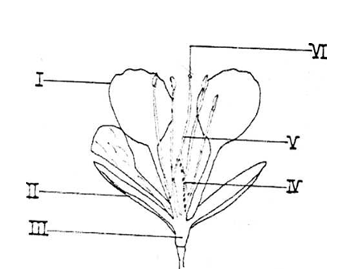
Which part of the flower is responsible for the protection of young flower buds?
Correct Answer: B. II
The essential parts of the flower are labelled
Correct Answer: D. I, II and III
Efficiency in insulin could lead to
Correct Answer: B. diabetes
Which of the following forms of energy is utilized during photosynthesis?
Correct Answer: B. Solar
Light is excluded from a water culture experiment in order to
Correct Answer: B. prevent ionization of water molecules
The major mineral present in the shell of Molluscs is
Correct Answer: A. calcium
The digestion of proteins starts in the
Correct Answer: C. stomach
Tooth decay is usually caused by
Correct Answer: B. the bacteria in the mouth that metabolize sugar to acids
The conversion of ammonium salts into nitrates is called
Correct Answer: A. nitrification
The salinity of a brackish habitat
Correct Answer: A. increases during the dry season
If 90 ants are found in a field with a total area of 100 m what is the population density of the ants?
Correct Answer: C. 0.90
The complex relationship between the members of a community and their physical environment is known as
Correct Answer: A. ecology
The specific role of a species within its environment is known as its
Correct Answer: C. niche
Which of the following soil fertility improvement methods will have the most negative effect on the ecosystem if not controlled?
Correct Answer: D. Application of N-P-K fertilizer
Organisms in an ecosystem are usually grouped according to their trophic into
Correct Answer: A. producers and consumers
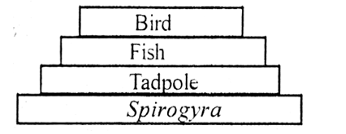
In the pyramid of energy illustrated above, the organism with the least amount of transferred energy
Correct Answer: D. Spirogyra
Tall trees with unbranched trunks which grow above the upper storey of the forest are commonly referred to as
Correct Answer: D. emergents
Maize grains are best stored against
Correct Answer: D. keeping in a silo
Cholera is mostly spread by
Correct Answer: B. water
Which of the following resources is renewable?
Correct Answer: A. Tree
Which of the following roles is not performed by a government agency responsible for forest maintenance?
Correct Answer: A. Regulating mining activities in the forests
Which of the following factors is not a source of variation in living organisms?
Correct Answer: B. Mitosis
Individuals with blood group AB can donate blood to individuals with blood group(s)
Correct Answer: D. A and B
The diagram below is an illustration of a process occurring in a living animal cell. Study it and answer questions 43 and 44.
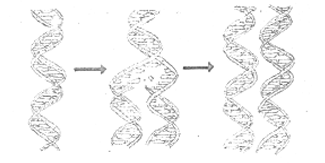
The process occurs in the
Correct Answer: D. nucleus
The process is called
Correct Answer: A. replication
Which of the following nucleotides is not found in the DNA molecule?
Correct Answer: A. Uracil
In a complete dominance monohybrid cross between pure breeding yellow flowered plant Y and a pure breading white flowered plant y, the result of the first filial generation is
Correct Answer: B. all yellow flowers
A man whose blood group is heterozgous B is married to a woman whose blood group is also heterozygous B. Which of the following statements is correct about the blood group of their four offspring?
Correct Answer: D. Three of them belong to blood group B
The cross between RrTt and rrtt where R is a gene for red colour and T for tallness will result in
Correct Answer: B. 50 % tall with red fruits
The yellow and black stripes on the body of wasps is an example of
Correct Answer: A. warning colouration
The biological importance of the dance by the worker honey bee is that it
Correct Answer: B. signals the availability of food
Theory Questions
(a)
(i) Complete the table below with the respiratory
surface of each of the listed organisms.
Organism |
Respiratory surface |
Tadpole (2 days old) |
|
Cockroach |
|
Domestic fowl |
|
Talinum |
|
Earthworm |
|
Amoeba |
(ii) State five characteristic features of respiratory surfaces in organisms. [5 marks]
(b) Make a drawing, 4 cm – 6 cm long of the respiratory organ in Tilapia and label fully. [9 marks]
Meat type |
Fat (%) |
Protein (%) |
|---|---|---|
A |
07.2 |
21.3 |
B |
25.3 |
10.6 |
C |
20.0 |
22.5 |
D |
03.1 |
28.2 |
E |
12.6 |
17.3 |
F |
13.2 |
14.3 |
(a)
(i)
Which two of the meat types may be recommended for an obese
patient? [2 marks]
(ii)State one reason for the answer in 2(a)(i). [1 mark]
(b)
(i) Which two of the meat types would provide the most
energy?[2 marks]
(ii) State two reasons for the answer in 2(b)(i). [2
marks]
(c) (i) Which three of the meat types could be recommended for a
child suffering from kwashiorkor? [3 marks]
(ii) State one reason for the answer in 2(c)(i) [1 mark]
(d) Which of the meat types would most likely be suitable
for:
(i) an active teenager; [1 mark]
(ii) a 70-year old human? [1 mark]
(e) Which other class of food provides energy? [1 mark]
(f) State three uses of fat in the human body. [3 marks]
(g) Describe briefly the procedure for testing for fat in a meat
sample using a piece of white paper. [3 marks]
(i) Remora and shark;
(ii) Lichen;
(iii) Cattle and white Egret;
(iv) Tapeworm in the gut of humans;
(v) Flowers and Honeybees;
(vi)Mistletoe and Cacao plant.
|
Parasitism |
Mutualism |
Commensalism |
|---|---|---|
(i) State three adaptive features of parasites. [6 marks]
(ii) State two effects of parasites on their hosts. [2 marks]
(c)
(i) What are saprophytes? [2 marks]
(ii) Give four examples of saprophytes. [4 marks]
Use the information below to answer questions 4(a)(i) and 4(a)(ii).
HbA represents normal haemoglobin,
HbS represents sickled haemoglobin.
(a) A female heterozygote for sickle cell married a sickler. With
the aid of a genetic diagram, determine the:
(i) possible genotypes of their offspring; [8 marks]
(ii) phenotypic ratio of the offspring. [2 marks]
(b) Explain briefly the reason why a Rhesus negative woman married
to a Rhesus positive man might lose her second pregnancy. [5
marks]
(c) Name two examples of features in animals that support the theory
of use and disuse of body parts as used by Lamarck. [2 marks]
(d) List three structures in mammals that are vestigial. [3
marks]
(a) Explain briefly the importance of the following factor and
organisms in the
nitrogen cycle:
(i) lightning; [3 marks]
(ii) Nitrosomonas; [2 marks]
(iii) Azotobacter. [2 marks]
(b) Name the excretory organ in:
(i) insects: [1 mark]
(ii) earthworm. [1 mark]
(c) Explain briefly the following diseases:
(i) hepatitis; [4 marks]
(ii) kidney stones. [4 marks]
(d)
(i) State three effects of lack of sense receptors in the
skin to humans.
[3 marks]
(ii) List three layers of the epidermis in the skin of humans. [3
marks]
(e)
(i) What is metamorphosis? [2 marks]
(ii) State the type of metamorphosis exhibited by each of the
following insects listed in the table below.
|
Insect |
Type of metamorphosis |
|---|---|
|
Grasshopper |
|
|
Cockroach |
|
|
Butterfly |
|
|
Mosquito |
|
|
Housefly |
Practical Questions
List of Specimen
Specimen A - thermometer
Specimen B - rain gauge
Specimen C - meter rule
Specimen D - sweep net
Specimen E - wind vane
Specimen F - quadrat
Specimen H - quill feather
Specimen J - palm frond
Specimen P - cockroach
Specimen Q - grasshopper
Study specimens A, B, C, D, E and F and answer questions 1(a) to 1(e)
(a) Name one branch of Biology which involves the use of
specimens A, B, C, D, E and F. [1 mark]
(b) State one functions each of specimens A, B, C, D, E and F.
[6 marks]
(c) Describe briefly how each of specimens B and D could be
used. [6 marks]
(d) Make a drawing, 10 cm to 12 cm long of specimen D and label
fully.
[8 marks]
(e) Name two organisms each associated with the use of specimens
D and F.[4 marks]
Study specimens H and J and answer questions 2(a) to 2(d)
(a)
(i) Name the kingdom and Class of organisms from which
specimen H could be obtained. [2 marks]
(ii) Name the specific location on the body of the organism from
which specimen H could be obtained. [1 mark]
(iii) Name one example of organism from which specimen H could
be obtained. [1 mark]
(b)
(i) State six observable structural differences between
specimens H and J.
[6 mark]
(ii) State three observable structural similarities between
specimens H and J [3 marks]
(c) State one function each of specimens H and J to the
organisms that possess them
[2 marks]
(d) Mention:
(i) three observable features that adapt specimen H to the
function stated against it in 2(c); [6 marks]
(ii) two observable features that adapt specimen J to the
function stated against it in 2(c). [4 marks]
Study specimens P and Q and answer questions 4(a) to 4(e)
(a)
(i) State the sex of specimen P. [1 mark]
(ii) Give one reason for the answer in 4(a)(i). [1 mark]
(b)
(i) Name the habitats of each of specimens P and Q. [2
marks]
(ii) State three adaptations each of specimens P and Q to their
habitats. [12 marks]
(c)
(i) State one observable structural difference between
specimens P and Q.
[1 mark]
(ii) State three observable structural similarities between
specimens P and Q. [3 marks]
(d)
(i) Observe the mouthpart of specimen Q and state its
feeding mechanism. [1 mark]
(ii) List one food item which specimen Q feeds on. [1 mark]
(e) Remove carefully one of the legs on the right side of the
metathorax of specimen P. Make a drawing, 6 cm to 8 cm long of
the removed leg and label fully.[8 marks]